Lisa Su Driving Forces Behind AI Computing and Semiconductor Innovation at AMD
- Sep 25, 2025
- 3 min read
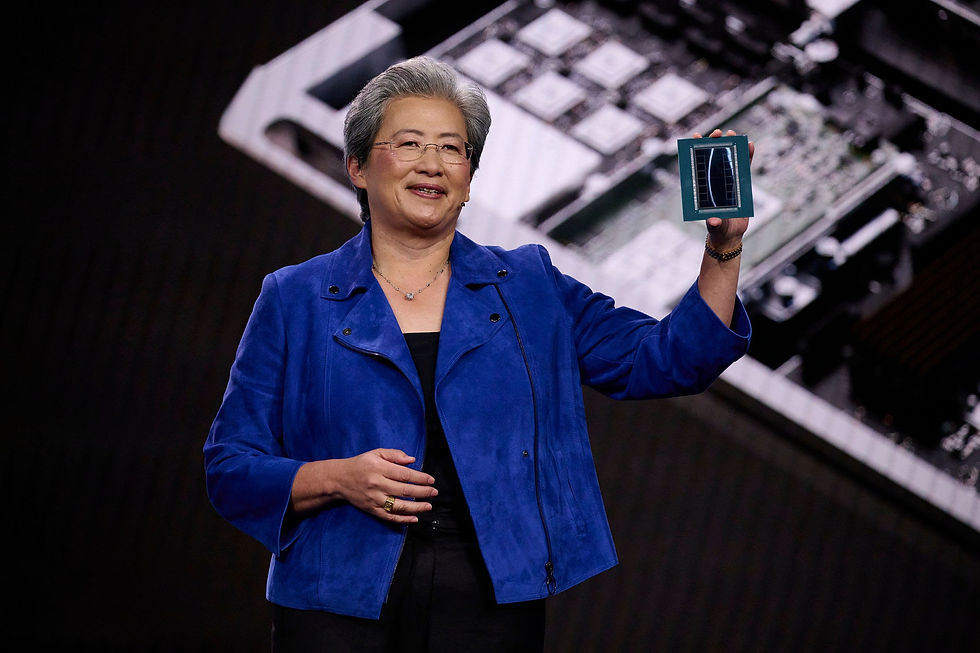
Lisa Su stands as one of the most influential leaders in technology today. As the CEO of AMD, she has guided the company through a remarkable transformation, positioning it at the forefront of AI computing and semiconductor innovation. Her leadership has not only revived AMD’s competitiveness but also reshaped the industry’s approach to high-performance computing. This post explores how Lisa Su’s vision and strategies have driven AMD’s success and advanced the future of AI and semiconductors.
Early Vision and Leadership Style
When Lisa Su took the helm at AMD in 2014, the company faced significant challenges. AMD was trailing behind competitors in both market share and technology. Su’s approach combined deep technical knowledge with clear strategic focus. She emphasized innovation, efficiency, and customer-centric design, which helped AMD regain trust and relevance.
Her leadership style is marked by:
Technical expertise: Su holds a PhD in electrical engineering, giving her a strong foundation to understand complex semiconductor challenges.
Decisive action: She made bold moves to refocus AMD’s product lines and invest heavily in research and development.
Collaborative culture: Su fostered teamwork across engineering, marketing, and sales to align efforts toward common goals.
This combination allowed AMD to develop products that met the growing demands of AI workloads and computing power.
Driving AI Computing Forward
AI computing requires processors that can handle massive data and complex algorithms efficiently. Under Lisa Su’s leadership, AMD has made significant strides in this area by developing powerful CPUs and GPUs tailored for AI applications.
Key Developments in AI Hardware
EPYC Processors: AMD’s EPYC server processors deliver high core counts and memory bandwidth, making them ideal for AI training and inference tasks.
Radeon Instinct GPUs: Designed specifically for machine learning, these GPUs provide the parallel processing power needed for AI model development.
Infinity Architecture: AMD’s architecture allows seamless communication between CPUs and GPUs, improving performance in AI workloads.
These innovations have helped AMD compete with industry giants and gain traction in data centers and cloud computing environments where AI is rapidly expanding.
Real-World Impact
Several companies have adopted AMD’s AI-focused hardware to accelerate their projects:
Cloud providers use EPYC processors to power AI services with better cost efficiency.
Research institutions leverage Radeon Instinct GPUs for deep learning experiments.
AI startups choose AMD platforms to build scalable, high-performance solutions.
This growing ecosystem reflects AMD’s influence on the AI computing landscape.
Semiconductor Innovation Under Su’s Guidance
Semiconductors form the backbone of modern electronics, and innovation in this field is crucial for advancing technology. Lisa Su has prioritized semiconductor research and manufacturing improvements to keep AMD competitive.
Advanced Manufacturing Processes
AMD shifted to cutting-edge manufacturing nodes, such as 7nm and 5nm technologies, through partnerships with foundries like TSMC. These smaller process nodes enable:
Higher transistor density
Lower power consumption
Improved performance per watt
This transition has allowed AMD to produce chips that outperform competitors in speed and energy efficiency.
Chip Design Innovations
Su’s team introduced chiplet design, breaking large processors into smaller, interconnected components. This approach offers several advantages:
Easier scalability for different product lines
Reduced manufacturing costs
Faster time to market
Chiplets have become a key factor in AMD’s ability to deliver versatile and powerful processors.
Commitment to Sustainability
AMD under Su has also focused on reducing environmental impact by improving energy efficiency and adopting sustainable manufacturing practices. This commitment aligns with broader industry trends and customer expectations.
Challenges and Future Directions
Despite AMD’s impressive progress, the semiconductor and AI fields remain highly competitive and fast-changing. Lisa Su continues to face challenges such as supply chain constraints, geopolitical tensions, and the need for continuous innovation.
Looking ahead, AMD aims to:
Expand AI capabilities with next-generation processors
Explore new materials and architectures for semiconductors
Strengthen partnerships across the tech ecosystem
Su’s leadership will be critical in navigating these complexities and maintaining AMD’s momentum.
Lessons from Lisa Su’s Leadership
Lisa Su’s journey offers valuable insights for leaders in technology and beyond:
Deep expertise matters: Understanding the technical details enables better decision-making.
Bold focus drives results: Concentrating resources on key areas can turn around struggling companies.
Innovation requires collaboration: Breaking down silos accelerates progress.
Adaptability is essential: Staying ahead means embracing change and new ideas.
Her example shows how strong leadership can transform an organization and influence an entire industry.


